UPC set to start on 1 April

11 October 2022

The Unified Patent Court (UPC) has announced that they plan to open the doors to the Court on the 1 April 2023. We therefore advise all patent proprietors who have not yet done so, to review your patent portfolios and decide on your strategy with regard to the new Unitary Patent System. The first decision you need to take is whether to opt-out from the UPC or not. Our patent attorneys are, of course, available for any questions or advice you may need – or for the lodging of opt-out requests.

As of its starting date, the Court will handle patent disputes and the Court’s decisions will have unitary effect in all participating UPC member states. As we have reported on previously, the UPC will, apart from disputes regarding Unitary Patents (UPs), also have jurisdiction over granted and nationally validated European patent (EP) applications in the participating UPC member states – as long as no opt-out from the UPC has been filed.

When the UPC has started, it will also be possible to register patents granted by the European Patent Office (EPO) as Unitary Patents (UPs). A Unitary Patent (UP) is a patent with unitary effect in all of the participating UPC member states. Currently, this includes 17 EU countries, Sweden being one of them.

The UPC also announced that the sunrise period that precedes the opening of the Court is expected to start on the 1 January 2023. During the sunrise period, it will be possible to file opt-outs from the UPC for nationally validated European patents (EPs), which will ensure that the patents remain solely under the jurisdiction of the national courts in the same way as it works today. By filing opt-outs from the UPC, a patent proprietor can thus avoid a central revocation action, but simultaneously resigns their ability to, through a single infringement action, stop infringement in all the participating UPC member states in one go.

Since the preliminary starting date has been announced by the UPC, we advise all patent proprietors to review their patent portfolios as soon as possible to decide on your strategy with regard to opting out from the UPC or not. Our patent attorneys are, of course, available should you have any questions about the UP, the UPC, or the filing of opt-outs.

Please note that the above-mentioned dates are preliminary and therefore might be subject to change.

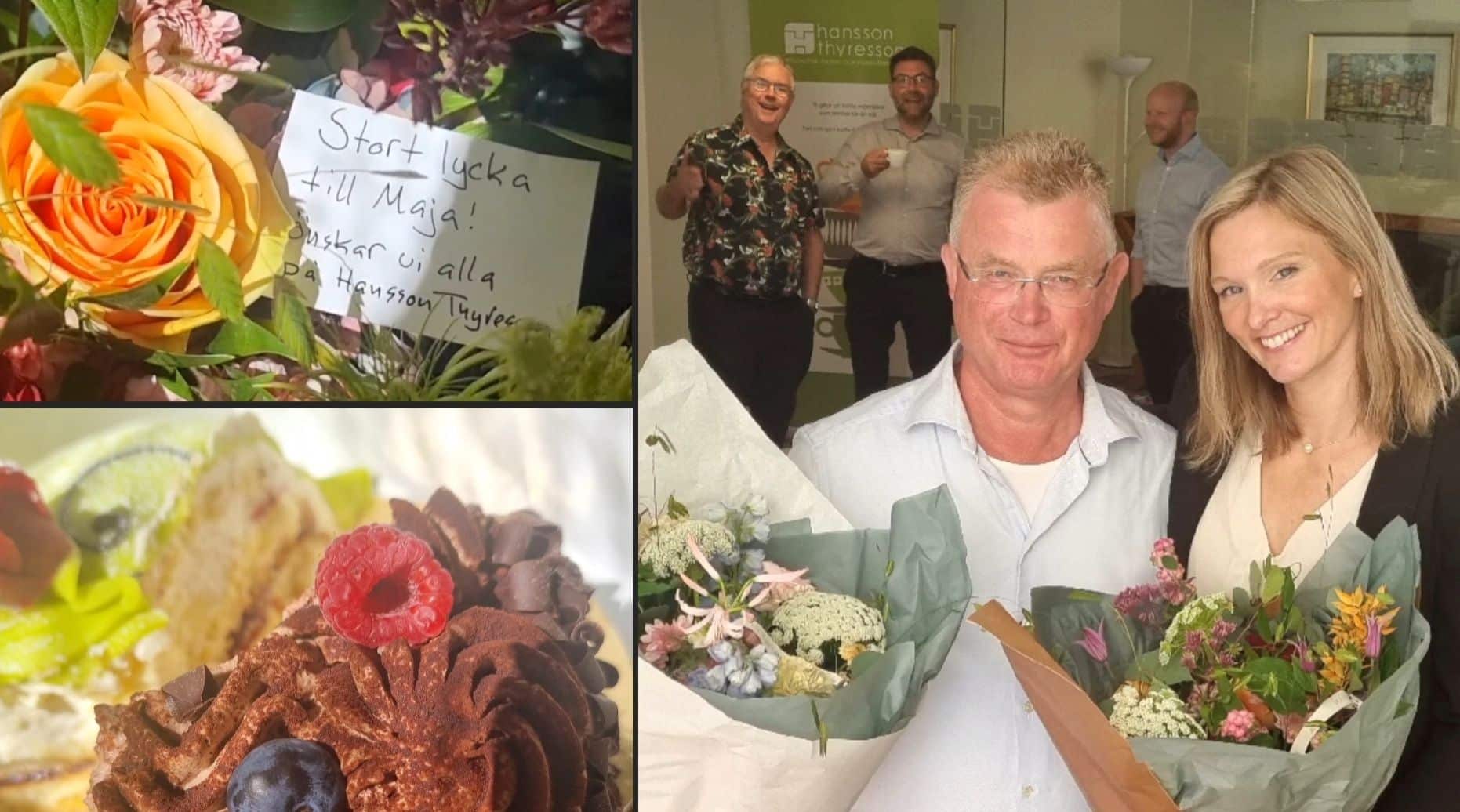
We welcome our new CEO Maja Modigh

vd-skifte

We are pleased to announce Maja Modigh as the new CEO of Hansson Thyresson AB, effective from 1 September 2022. Maja takes over after Lars Thyresson who has successfully led the organisation since its foundation. Maja has worked at the firm since 2018 with HR and Finance as her main areas of responsibility. She has, together with Lars, been part of the firm’s management as Vice President. As an active member of the firm’s Board, Maja has a good insight into the firm’s history and development.

“Anders and I founded Hansson Thyresson 28 years ago with an open mind and focus on making a difference for our clients in achieving the best possible outcome given the specific circumstances in every single case. As CEO, and with Anders as chairman of the Board, we have for the past ten years more than doubled both our revenue and our number of employees. We are a cheerful team who give everything in our pursuit of the best for our clients. It is with pride and happiness that I now pass the baton to Maja. Maja possesses the courage, understanding, and passion required to successfully steer the company on our chosen path.” Lars Thyresson

Lars will remain part of the firm as Director of the Law and Trademark department. He will also, together with Maja and Jonas Delander, continue as a member of the management committee. Both Anders Hansson and Lars Thyresson will remain on the Board, which from 1 September 2022 is led by the new Chairman Mats Jacobson.

“I am thrilled about the opportunity to manage, but also develop, Hansson Thyresson further. We have important work ahead of us in educating companies about intellectual property and helping them secure their most important assets. A task that feels both meaningful and exciting. We have a history of being a good employer with happy employees, low staff rotation and much generosity. I want to take that with me. It is obvious to me that everything starts there. Passionate and engaged colleagues who deliver high-level services ensures that our customers remain satisfied. I have many thoughts on how to continue our journey and I am really looking forward to being part of it. Together we will strive to make sure that every company understands and secures their intellectual properties. That’s also our new vision.” Maja Modigh

With Maja in charge, the firm and our employees have an exciting future ahead.


The UPC is coming – are you ready?

Have you heard of the new patent system that is about to launch in Europe? Do you know how it will affect both your existing and future patent rights? Or maybe you are sighing because it sounds like you will have to take even more decisions in relation to your patent portfolio? Don’t worry, we are here to help you and will guide you to the decisions most suitable for your organisation.

The introduction of the Unitary Patent and the Unified Patent Court represents a major change in the European patent landscape. This new system, offering unitary patent protection across many EU states, is finally, after years and years in making, actually on the way.


The Unitary Patent
The Unitary Patent (UP) is, as the name suggests, a single patent with unitary effect in all participating countries. At the moment, this includes 17 countries across the EU, with Sweden, of course, being one of them. Further EU countries may be added as time progresses, but it is worth noting the new system is an EU initiative and that non-EU countries are not and will not be part of it.

When the new system has arrived, it will no longer be necessary (although you can still choose to do so) to validate a granted European Patent (EP) individually in all the countries of interest. Instead, you can obtain a single patent covering all participating countries, meaning only one payable renewal fee for all those countries, only one translation necessary for all those countries, and the possibility to stop infringement in all those countries through one single infringement action. This will likely be a pleasant development for many applicants. However, UPs also have some drawbacks to be aware of, the most important one being the risk of a central revocation action which can invalidate your UP in all the participating countries in one go.

The new UP system will function in parallel to the current system, and it will, as mentioned above, still be possible to validate EPs in individual countries as you do now.


The Unified Patent Court
With the arrival of this new UP system, a new court, the Unified Patent Court (UPC), is also introduced. The UPC will be the court where litigation of UPs (both revocation and infringement actions) takes place, and decisions by the UPC will have unitary effect throughout all of the participating countries.

However, importantly, the UPC will also have jurisdiction over all EPs validated in the classical way in participating countries, this applies even to EPs granted prior to the launch of the UPC. In other words, if you have a patent granted by the EPO, it falls under the jurisdiction of the UPC once the UPC is up and running, unless you choose to opt-out from the UPC, see below.


UPC


The possibility to opt-out
During a transitional period of 7 years (possibly extended to up to 14 years) from the start of the UPC, the proprietor of a classically validated EP can opt-out that patent from the competence of the UPC, provided that no action has already been taken in relation to that patent at the UPC.

Opting out an EP means that the patent will fall under the sole jurisdiction of the national courts for the lifetime of the patent, in the same way as it is today. However, a decision to opt-out can be withdrawn (opt-in) provided that no action in the meantime has been brought against the patent before a national court. The possibility to opt-out applies to any EP granted or applied for prior to the end of the transitional period, and it will be possible to file opt-outs from the start of a so-called sunrise period. The sunrise period starts 3-4 months before the launch of the UPC and ends at the start of the transitional period.


When will the new system launch?
It is still uncertain exactly when the new system will launch, but it could happen as early as October 2022, or perhaps more realistically in early 2023. When Austria in January 2022 became the thirteenth country to participate in the provisional application of the UPC agreement, the preparations for the launch of the new system started. Once the preparations are sufficiently far along, Germany, acting as the Gatekeeper, will deposit its instrument of ratification, which will initiate the sunrise period.


Decisions, decisions, decisions
The introduction of the UP and the UPC will have implications for all applicants and patent proprietors interested in patent protection in EU countries. All proprietors and applicants should consider how to take advantage of the opportunities that are offered by the new system while also protecting themselves against any drawbacks that may arise.

As a patent proprietor, the most important thing to note is that if you do nothing, things will change for you. It is therefore time to start thinking about the UPC so that you can make informed and strategic decisions, rather than letting the decisions be made for you.

The first decision you need to take is whether to opt-out your existing EPs and EP applications from the UPC. It is far from an easy decision, and there are many considerations to take into account. Seeing that the new system, and the sunrise period, is only months away, we would advise all EP proprietors to start reviewing their patent portfolio in order to decide on a strategy.

We are, of course, here to help you, and given the potential impact of any strategic decisions you may take (or indeed not take), and the complexity of the new patent landscape, we are always available for a meeting where we can give you the advice that you need.

Please feel free to contact any one of us if you have any questions in relation to the UP, the UPC, or any other aspect of intellectual property.

 

deWiz Golf AB is building an IP portfolio

deWiz Golf AB is building an IP portfolio for securing and increasing the value of its Intangible Assets. Hansson Thyresson was early trusted to work with all aspects of intellectual property services, such as patents, trademarks, and contracts.

deWiz Golf AB is an extremely interesting young technology company that has developed a golf training platform. It was founded by former European Tour pro, PGA of Sweden certified instructor and motor learning author, Markus Westerberg, and entrepreneur and technology business leader, Christian Bergh. The company’s mission is to help golfers around the world elevate their enjoyment of the game through innovative technology that accelerates the pace of learning. To accomplish this, deWiz has developed a revolutionary wearable technology that helps you analyze your swing motion. And what makes deWiz unique is when you break your preset parameters, deWiz generates a tickling electric pulse and audible alert in real time.

– It´s been one of the most exciting journeys in my patent attorney carrier. Starting from zero with two engaging and dedicated inventors, we’ve created an IP portfolio to protect the fantastic new device and to assist in the business development of the company. The product and services around deWiz continue to grow, as does the IP portfolio.
Anders Hansson, co-founder, and chairman of the board of Hansson Thyresson AB.

The development of the IP portfolio has been a continuous process where technical, legal, marketing and business aspects have evolved at different speeds and importance. The value of the IP portfolio and other Intangible Assets cannot be overestimated.

I can’t express enough the importance of having a homogeneous portfolio of patents and trademarks registered in a wide range of countries, partly to protect your invention, but especially when you need to increase the capital of the company and bring in investors. It costs a lot of money to apply for a patent, but the benefits outweigh the costs.
Christian Bergh CEO deWiz Golf AB


Markus Westerberg, co-founder and golf professional – responsible for the golf technique in the development work.

Important information regarding COVID-19 virus

We herewith assure our clients and partners in Sweden and internationally that we will maintain business as usual, although physical meetings may be postponed. We expect to remain fully operational. All our case handling and work procedures are fully electronic. Some of our staff will work remotely until further notice.

We are doing our utmost in order to comply with current recommendations from the Swedish Government and authorities provided to reduce spread of the virus.

For additional information please do not hesitate to contact us by email: info@hanssonthyresson.se or by phone +46 40 30 00 14.

Thank you very much for your understanding!

Best wishes!

Lars Thyresson
CEO – Hansson Thyresson AB

Will EPO examinations converge with the new US guidelines on eligibility?

The two major questions are: Will there be a convergence in interpretation with the EPO’s guidelines from last year regarding AI and machine learning? How will US applicants with an interest in the European markets act?

The new USPTO guidelines will hopefully straighten out the problems for PTO examiners as well as judges regarding the eligibility for patentability of software. In this situation eligibility means that the invention is considered as an abstract idea and as such not patentable since abstract ideas have been deemed basic tools of scientific and technological work.

The Alice/Mayo test, named after two previous Supreme Court judgements, has been applied in the examination of a number of software applications where the subject matter claimed in the application has been considered non-eligible, without any consideration if this subject matter has been identified as an abstract idea.

A two-step analysis
The new guidelines provide an analysis in two steps, starting by considering if the subject matter might be identified as an abstract idea. This examination is supported by a model for grouping
abstract ideas, namely mathematical concepts, methods for organizing human activity and mental processes.

If a subject matter is identified as an abstract idea, there is still a possibility for it to be considered eligible, namely if the subject matter is integrated into a practical application. When examining if
such eligibility is at hand, the claim as a whole has to be considered, i.e. including all additional elements, whether or not they are conventional or abstract and as such not eligible.

Exemplary considerations
The guidelines provide a set of exemplary considerations for this examination. If an additional element reflects an improvement in the functioning of a computer, to another technology or technical field; effects a particular treatment or prophylaxis for a disease or medical condition; is used in conjunction with a particular machine or manufacture; effects a transformation or reduction of a particular article to a different state or thing; in a meaningful way links the use of an abstract idea to a particular environment; then the subject matter might be considered eligible.

What about Europe?
The EPO launched new guidelines directed towards AI and machine learning applications in 2018, most probably with the same intentions as the USPTO, i.e. enhancing the European and American ambitions to become the world technology leader in software, especially in AI and machine learning.

The EPO guidelines do not apply the two-step analysis of the USPTO guidelines. The examiners of the EPO are looking for technical effects supporting a technical purpose if a claim describes abstract elements or comprises abstract references.

Presently, there is no new case law based on the EPO guidelines, but it is apparent that the new guidelines have been applied in several cases of the EPO examinations.

The present situation – and what to do
The overall impression when prosecuting patent applications in both the EPO and the USPTO is that there is a tendency in the EPO examinations to look for triggers, i.e. elements supporting a technical
effect, not the technical effect as a result of an accumulated effect of all elements presented, including the abstract or conventional elements contributing to the overall technical effect obtained. USPTO examiners on the other hand tend to look for the accumulated effect, including abstract or conventional elements contributing to the practical use.

Unfortunately, this leaves us in a situation where EP applications based on priority from US applications often are confronted with a tougher view in the examination at the EPO than in the USPTO, resulting in patented inventions for the US market but in rejected applications in the EPO regarding the European markets.

Furthermore, this raises the question for US applicants with a view towards European market to review their US applications before filing in order to meet the EPO requirements.

Since both the USPTO and the EPO have declared that their new guidelines are steps forward for putting the US and Europe on the top globally as the most AI and machine learning friendly areas, let us just hope that there will be some convergence in the interpretation of patent claims in accordance with the new guidelines.

By Jonas Delander & Viveka Anderberg

Jonas Delander is a Swedish and European Patent Attorney, MSc (E), mainly focusing on advice and patent prosecution in the fields of software and Artificial Intelligence. For several years he held a position as Senior Patent Counsel at one of Sweden’s most successful IT companies, then focusing on the patenting aspects of digitalisation. Get in contact with Jonas here >


Viveka Anderberg is a Swedish and European Patent Attorney, MSc (Ph). Her focus is on digitalisation, mechanics and electronics. She has a vast experience in international patent prosecution with a particular interest in US filings. Get in contact with Viveka here >

What will happen with BREXIT- deal or no deal?

Will all European registrations become null and void when Britain leaves the EU? How will our sole rights be affected if there is a leave with a deal or not?

Brexit will definitely have an impact in some respects. But it will differ depending on if focus is on patents, trademarks or designs.

Patents
Member states of the European Patent Convention, the basic legal framework for European patents, do not have to be members of the European Union. Accordingly, a British leave will not have any impact on the validity of the rights registered by the European Patent Office, the EPO.

All European patents, whether pending applications, just granted patents not yet validated or validated in each country of interest, will still be in force and in no way touched by the British leave.

Trademark and design protection
Trademark and design applications in the EU are filed with the EUIPO, an administrative authority of the European Union. When Britain leaves, this opportunity of filing EU applications will cease, as far as Britain is concerned.

If there is a Brexit with a deal, a transition period until December 31, 2020 will be initiated. During this period new British registrations will be “cloned” on the EU registrations. This will take place automatically and free of charge. The proprietor of the trademark or design will not be required to take any action.

Pending EU applications will not be cloned, but has to be filed as British applications. The filing date will be the same as for the EU application if the British application is filed within nine months from the date of leave.

If there is a no-deal Brexit, nobody knows what will happen to the present EU trademark and design registrations regarding their validity in Britain. The British government has proposed provisions for this situation quite similar to the ones adopted for a deal situation, but these are just proposals.


By Anders Hansson & Lars Thyresson

So, there is no such thing as a Swedish “grogg”?


The Grand Board of EUIPO has concluded that there is no risk of confusing similarity between the trademark ICEBERG for vodka and the trademark ICEBERG for mineral water and fruit juice.

This decision was preceded by an Opposition Division decision upholding the opposition on the grounds of likelihood of confusion.

When making conclusions on likelihood of confusion, there are, according to European practice and academic discourse, a few things to keep in mind.

  1. The situation to study in which the confusion arises is the actual shopping situation when the consumer is picking goods from the shelves, not a theoretically constructed environment
    where EU directives defines our perception of the world.
  2. The cumulative effect of similarity, i.e. the consumers overall impression of similarity regarding the marks and the similarity regarding the goods or services, meaning that when the similarity regarding the marks is low, the similarity regarding the goods or services has to be high to cause a confusion. On the other hand, as in this case, when the marks are identical, the similarity of goods does not have to be that high, rather low, to cause a confusion.
  3. The administrative procedures ability to support the applicant and thereby finding the truth in the case, not the procedure of the civil courts of law where the court only judges on what is claimed by the parties.

In case R 1720/2017-G and the decision of 21 January 2019, the Grand Board of Appeal, reasons otherwise in all these aspects.

The marks, ICEBERG and ICEBERG, are considered identical.

The Grand Board agrees with the Opposition Division that the goods are similar to a low degree when directed at the public at large. They also agree that the public at large could be considered to have a level of attention to be average. This would have been in line with the principles of studying the situation in which the actual confusion arises, see 1 above.

A turning point
However, when the Grand Board starts analyzing the target group for vodka consumers and finds them “reasonably well-informed and reasonably observant and circumspect”, the door is opened for what is sometimes called “the method of analytical reduction”.

Even though the marks have been considered identical and the similarity regarding the goods hence
could be low, see 2 above, the Grand Board presents us with a reasoning separating “vodka” from “mineral water” and “fruit juices” by referring to EU directives defining these liquids in detail – ending with the finding that “vodka” is drunk “neat”, i.e. without ice or soft drinks.

The fact that pre-mixed alcoholic drinks do exist and that some of the market leaders do include vodka is just swept away by stating that there is no evidence – and “this has not been argued by the opponent”; which in our opinion does not comply with the objectiveness of the administrative procedure, see 3 above.

This decision by the Grand Board has – unfortunately not – been challenged by bringing it before the General Court of The European Community.

However, in Scandinavia, where we used to sail our longships between the icebergs to conquer the world, we will also this summer keep up the old tradition of mixing vodka with mineral water or soft drinks and having a Swedish “grogg”.


by Lars Thyresson & Maria Foskolos

Thank you! For stopping them!

Not the most common words to hear from your biggest competitor in the industry. But it happened in Munich this spring. At BAUMA, the world’s leading construction machinery trade fair.

One of our clients, a market leader within their business segment, quickly identified a suspicious patent infringement in a competitor’s stand at BAUMA.

A direct call to one of our lawyers with a vast experience in coordinating global Intellectual Property disputes for a multi-national Swedish company had an immediate effect.

  1. Wednesday morning a German colleague met with the client at the fair. Together they looked at the competing product and agreed that this was an infringement. As a consequence thereof a senior German attorney immediately started working on a cease-and-desist letter.  This letter was sent to the competitor’s headquarters at 10.30 pm on the same day, i.e. Wednesday, April 10. The due time for response was set to 11.00 am on Thursday, April 11, i.e. the very next morning.
  2. The competitor, who obviously was well prepared for the infringement accusation, at 11.30 am the following morning returned a 24-page long letter claiming that the patent should be null and void and, accordingly, there was no infringement.
  3. However, already at 9.30 am when the trade fair opened on Thursday morning, our client checked the competitor’s stand and found that the infringing product had been removed.

Shortly thereafter, a top executive of the largest and very serious competitor came over to our client and thanked them for keeping the business clean by taking action against infringers.

This action then became the talk of the day of this years’ BAUMA trade fair and made our client’s name known throughout the industry.


by Maria Frödin & Anders Hansson

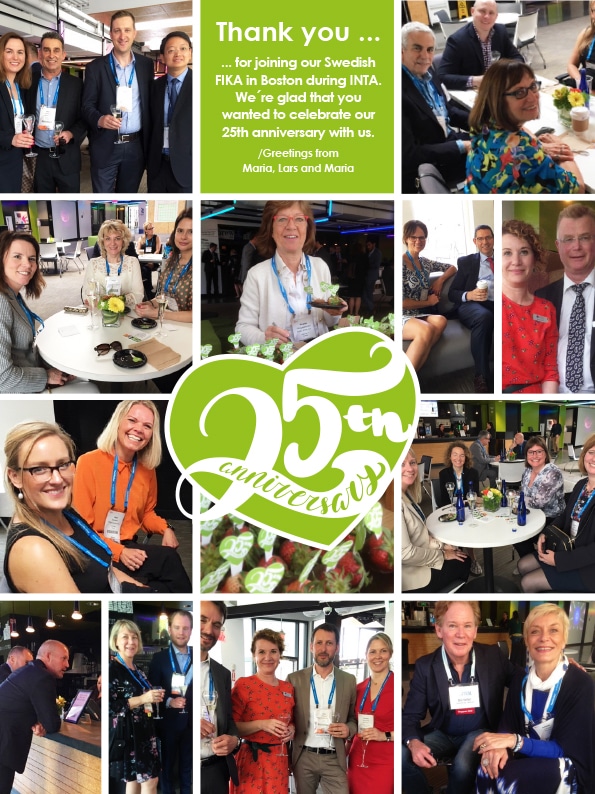
Our “Swedish fika” in Boston during INTA

A warm thanks to everyone who came to our reception for a “Swedish FIKA”. We had intensive days in Boston at the INTA Global Annual Meeting, which is the largest and most influential gathering of professionals. We can state that a really good start is to meet for a cup of coffee! Meeting after meeting has created good conditions for future collaboration.

/ Maria Foskolos, Lars Thyresson and Maria Frödin